
CORE MATERIAL COMPARISON
PU vs. EPS Core in Insulated Metal Wall Panels: What Changes in Real Projects
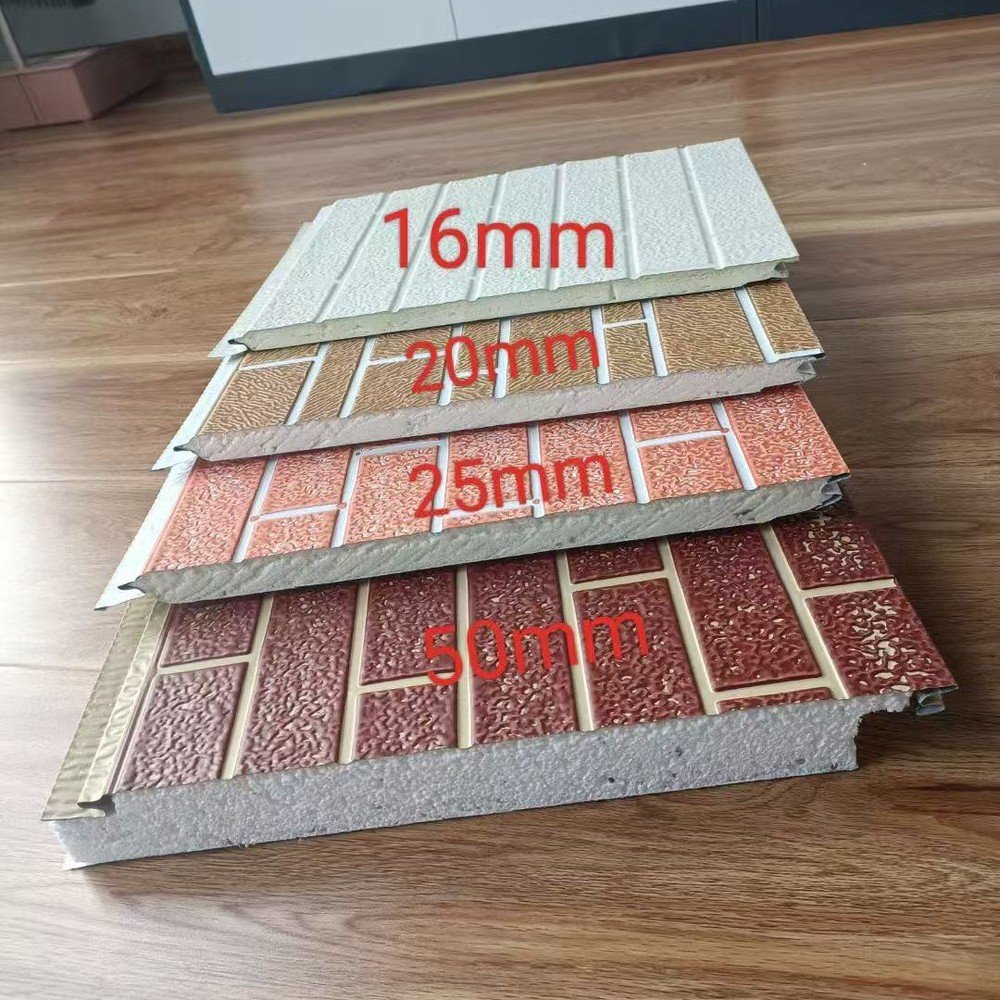
Both PU and EPS insulated metal panels can carry the exact same embossed wood, brick, or stone steel exterior. The core you pick changes wall thickness, dent support, and landed container cost.
On this page
Buyers sourcing exterior insulated wall panels between 16 mm and 100 mm often ask whether paying extra for rigid polyurethane (PU) foam is worth it compared with molded expanded polystyrene (EPS). The answer depends almost entirely on how much wall thickness your building can spare.
Measured lab differences on the same Al-Zn steel face
In July 2026, Hunan TECC Testing Co., Ltd. (CNAS L23527 / ilac-MRA, Report ZJTB3307037563GR) tested both our PU-core and EPS-core exterior metal panels side by side under GB/T 23932-2025, JG/T 287-2013, and GB 8624-2012:
| Test parameter | Rigid PU core | Molded EPS core | Practical impact |
|---|---|---|---|
| Apparent density | 43 kg/m3 | 22 kg/m3 | PU provides nearly twice the foam backing mass behind the steel skin |
| Thermal conductivity at 25 C | 0.020 W/(m.K) | 0.033 W/(m.K) | 50 mm PU insulates roughly like 82 mm EPS |
| Compressive strength | 152 kPa | 118 kPa | Higher rigidity around screw flanges and accidental impacts |
| 24 h water absorption | 2.4% | 2.1% | Both show low closed-cell moisture uptake |
| Metal-to-core tensile bond | 0.16 MPa | 0.15 MPa | Both broke in the core substrate rather than debonding at the steel |
| Fire rating & oxygen index | Class B1 / 31.2% | Class B1 / 30.8% | Flame-retardant grades under GB 8624-2012 |
When rigid PU is the clear winner (16 mm to 30 mm)
In thin decorative wall panels – 16 mm, 20 mm, and 25 mm – every millimeter counts. At 16 mm, rigid PU not only delivers 65% stronger thermal resistance than EPS, its 43 kg/m3 closed-cell structure also acts as a firmer structural backing behind the thin embossed steel face. In continuous foaming, liquid PU expands directly into the embossed steel ribs, creating a tight mechanical bond without separate glue lines.
When molded EPS makes practical sense (50 mm to 100 mm)
Once a project moves into thicker 50 mm, 75 mm, or 100 mm walls – such as workshops, budget modular enclosures, or large agricultural buildings where extra wall depth does not eat valuable indoor floor space – molded EPS lowers raw material cost per square meter while still hitting strong overall thermal resistance through added thickness.
Decision rule for container orders
- Choose PU for 10 mm, 16 mm, 20 mm, 25 mm, and 30 mm decorative siding where crisp embossing, dent resistance, and slim window reveals matter.
- Compare PU vs. EPS quotes on 50 mm, 75 mm, and 100 mm walls: choose PU if you need maximum thermal value in tighter wall depth, or EPS if you have wall space and want lower per-square-meter material cost.
- Request our stamped CNAS / ilac-MRA bilingual test dossier (Report ZJTB3307037563GR) alongside your quotation for engineering and project review.